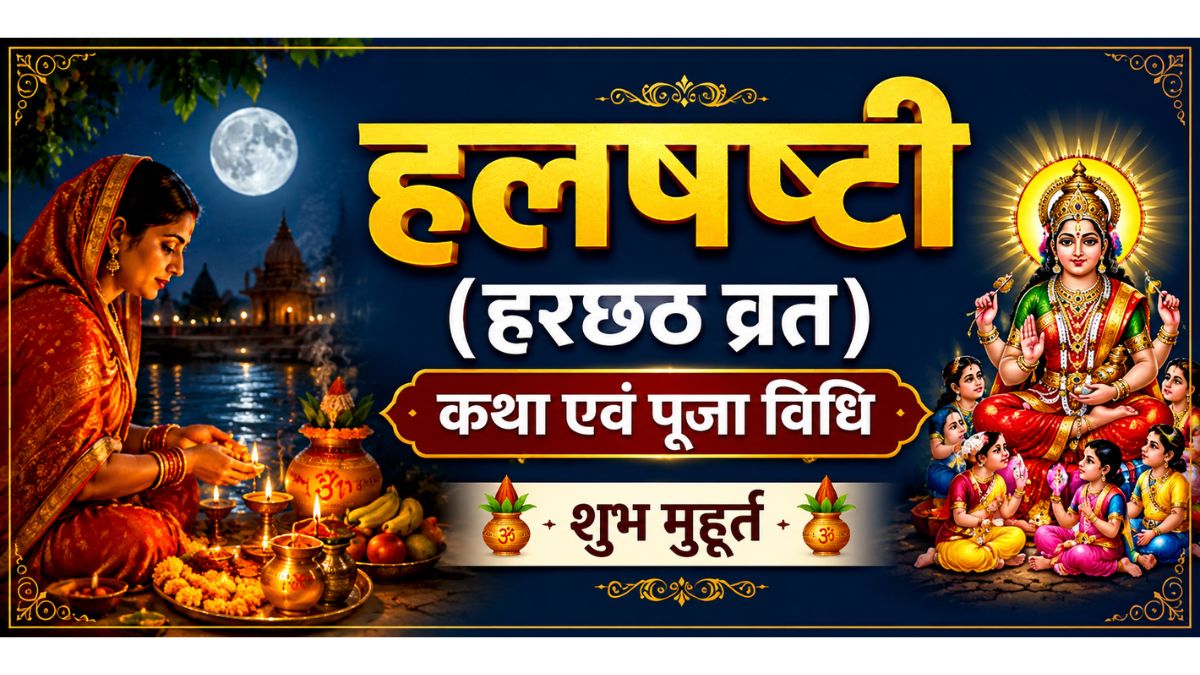
Here is the story and worship ritual for the Hal-Shashti fast, observed to pray for the long life of one’s children. This fast is observed on the Shashti (sixth day) of the dark fortnight (Krishna Paksha) of the month of Bhadrapada. In some regions, it is celebrated to mark the birth anniversary of Lord Balarama, the elder brother of Lord Shri Krishna, as Balarama was indeed born on this day.
Hal Shashthi Har Chhath Vrat Katha.
Here is the story and worship ritual for the Hal-Shashti fast, observed to pray for the long life of one’s children. This fast is observed on the Shashti (sixth day) of the dark fortnight (Krishna Paksha) of the month of Bhadrapada. In some regions, it is celebrated to mark the birth anniversary of Lord Balarama, the elder brother of Lord Shri Krishna, as Balarama was indeed born on this day.
sumir bhavani shadkarahi, ganpati ko shir nay,
halashishthi vrat ki katha, kahin puran vidhi gaay.
Once, King Yudhishthira said to Lord Shri Krishna, “You have incarnated solely for the welfare of the world. At this moment, Subhadra and Draupadi are grief-stricken over the deaths of their sons, and the unborn child in the womb of Abhimanyu’s wife, Uttara, has been struck by Ashwatthama’s Brahmastra. Parents suffer immense anguish when deprived of their children. Therefore, O Lord, please prescribe a vow, an act of charity, or a remedy that ensures parents are spared the sorrow of losing their children and are blessed with excellent, healthy, and long-lived offspring.” Hearing this, the Lord replied, “O King! I shall tell you of a vow; if observed with due discipline, even a damaged fetus can be restored to life, and the child will not suffer.”
Hal Shashthi Vrat Katha Start
When Yudhishthira inquired, Lord Sri Krishna recounted that in ancient times, there lived a renowned king named Subhadra. His queen was named Suvarna, and they had a valiant son named Hasti, who founded the city of Hastinapura—naming it after himself. One day, the prince went to the Ganges with his nursemaid to bathe and began playing in the water. Suddenly, a crocodile dragged him into the depths. Upon hearing this, Queen Suvarna was overcome with grief, and in a fit of rage, she cast the nursemaid’s son into a blazing fire. Subsequently, the king and queen prepared to end their own lives.
Grieving for her son, the nursemaid also retreated to a secluded forest. There, in a solitary temple, she began worshipping Lord Shiva, Parvati, and Ganesha. After performing her daily prayers and meditation, she would subsist on wild grasses, grains, and Mahua flowers. The Lord said, “O King Yudhishthira, as she observed this vow, the power of her devotion brought about a miraculous event in the city on the day of the dark fortnight of the month of Bhadrapada: the nursemaid’s son suddenly emerged alive from the fire.” The King and Queen also witnessed the nursemaid’s son emerging from the fire and were astonished. They asked the learned sages the reason for his survival.
To reveal the secret behind this, Sage Durvasa arrived there at the behest of Lord Shiva. Upon his arrival, the King welcomed him, honored him with offerings such as Arghya, and—after repeatedly bowing in reverence—inquired about the reason for the nursemaid’s son emerging alive. Sage Durvasa replied, “O King! That nursemaid went to the forest and, with immense devotion and strict adherence to the rules, meditated upon and worshipped Lord Shiva, Lord Kartikeya, Goddess Parvati, and Lord Ganesha, while faithfully observing the prescribed vow.”
It is the power of this very vow that enabled the nurse to be reunited with her son while he was still alive. Therefore, you too should go there and perform this sacred ritual. Shri Krishna told King Yudhishthira that the King and Queen bade farewell to Sage Durvasa and then, taking the nurse along, went to the forest where she lived. There, the King, the Queen, and the nurse’s son saw the nurse worshipping Lord Shiva with great devotion beneath a Kusha grass and Palash (Dhak) tree. The King reunited the nurse with her son, and she explained the significance of this excellent vow to the King in detail.
She said, “O King! Ever since I came here, terrified of you, I have worshipped Lord Shiva, Kartikeya, Parvati, and Ganesha while subsisting solely on air. One day, at midnight, Lord Shiva appeared to me in a dream and said, ‘Your son is alive because you have worshipped us with such great devotion and reverence. If your Queen also observes this vow according to the prescribed rituals, she too will be reunited with her son, and she will be blessed with many more sons.'”
Lord Shri Krishna said to King Yudhishthira, “O King! This excellent vow should be observed on the Shashthi (sixth day) of the dark fortnight (Krishna Paksha) in the month of Bhadrapada. On that day, one should bathe in the morning and, renouncing anger, greed, and attachment, perform the vow in accordance with the prescribed rules.”
Throughout the observance of the vow, one must not harm any living being; to ensure the vow is fulfilled perfectly, one should not even step across the path of creatures like ants. In the afternoon, accompanied by friends, one should install idols of Lord Shiva, Parvati, Swami Kartikeya, and Ganesha beneath a Palash (Dhak) or Kusha tree. There, one should worship them with humble devotion—offering incense, lamps, and ritual food—and offer this prayer: “O Lord Shiva—gentle of form, five-faced, wielder of the trident, and accompanied by attendants like Nandi, Shrungi, and the mighty-bodied Ganas—I offer you my prostrate salutations.”
“I offer salutations to Gauri and Mother Parvati—the beloved of Shiva, the supreme embodiment of Prakriti (Nature), and the bestower of good fortune. O Lord Kartikeya—rider of the peacock, Kumara, Vishakha, Skanda, and the one who split the Krauncha Mountain—I bow to you again and again.” Then, one should invoke the single-tusked Lord Ganesha, saying: “O Lord! O Mushakavahana (rider of the mouse) and Lambodara (pot-bellied one), I offer you my prostrate obeisance.”
In this manner, one should properly worship these four deities. Afterward, accompanied by Brahmins and amidst festive music, one should return home. On that day, one should consume a meal made of Sama rice and partake specifically of curd, milk, ghee, and buttermilk. Shri Krishna said, “O King! Any man or woman who observes this vow according to the prescribed rituals finds happiness and is blessed with sons and grandsons.” Hearing these words from the Dhatri (nurse/attendant), the King and Queen observed the vow with due ritual propriety; through its power, the royal son was soon released from the grip of the Graha (malevolent spirit) and began to speak.
Witnessing this miracle, the King and Queen bowed at the feet of Lord Shiva. Through the power of this fast, the King was blessed with several more long-lived sons; furthermore, calamities such as drought, epidemics, and famine were dispelled from the kingdom, and the King continued to rule without hindrance for many years.
Salutations again and again to Skanda—Lord Kartikeya. Then, one should offer prayers to the single-tusked Lord Ganesha, saying, “O Lord! O One who rides a mouse and possesses a large belly, I offer my prostrate obeisance to You.” In this manner, one should duly worship these four deities. Afterward, accompanied by Brahmins and amidst festive music, one should return home. On that day, one should consume a meal of Sama rice and partake specifically of curd, milk, ghee, and buttermilk.
Shri Krishna said, “O King! Any man or woman who observes this fast according to the prescribed rituals finds happiness, blessed with sons and grandsons.” Hearing these words from the nurse, the King and Queen performed the fast with due ritual observance; by its virtue, the royal prince was soon released from the grip of the aquatic creature and began to speak. Witnessing this miracle, the King and Queen bowed at the feet of Lord Shiva.
Through the power of this fast, the king was blessed with several more long-lived sons; furthermore, calamities such as drought, epidemics, and famine were dispelled from the kingdom, and he continued to rule without hindrance for many years.
Lord Sri Krishna said, “O Yudhishthira! If Uttara also observes this fast according to the prescribed rules, all her sorrows will be alleviated.” Hearing these words from the Lord, King Yudhishthira felt deeply fulfilled, and through the power of this fast, the unborn child in Uttara’s womb—which had been struck by Ashwatthama—was restored to life.
Observing this fast ensures the continuity and stability of the lineage. Lord Krishna narrated this account to King Yudhishthira, and the sage Durvasa advised King Subhadra, saying, “O King! After observing this fast, one must perform its concluding ceremony (Udyapan) in accordance with scriptural injunctions.”
Udyapan Vidhi of Halshasthi vrat
During the concluding ceremony (Udyapan), one should donate gold, a female buffalo, a cow, and garments to Brahmins. One should have an idol made of gold or silver and worship it in the company of Brahmins well-versed in the Vedas. Sage Durvasa said, “O King! Even the wise and righteous King Yudhishthira had Queen Uttara observe this vow; through its power, the fetus—which had been struck by Ashwatthama—began to stir within her womb, and that very fetus subsequently manifested as King Parikshit.” Any person who observes this excellent vow sees all their endeavors succeed; they are blessed with sons and grandsons, and they are worshipped in the realm of Shiva (Shivaloka).
End of katha Halshasthi